
The word “but” is one of the most common ways to show contrast, disagreement, limitation, or an exception in English.
It is short and useful, but repeating it too often can make your writing feel predictable.
That is why writers often look for synonyms for but that better match the sentence, tone, or context.
The key is that not every alternative to “but” means exactly the same thing.
Words such as however, yet, although, though, nevertheless, and nonetheless can express contrast, while except, apart from, and other than can express an exception.
Choosing the right alternative depends on what you actually want the sentence to mean.
Quick Answer
The best synonyms for but include however, yet, although, though, nevertheless, nonetheless, still, even so, in contrast, on the other hand, despite this, and whereas. For exceptions, alternatives such as except, apart from, other than, and excluding may work better. The correct choice depends on grammar, meaning, and tone.
Quick List of Synonyms for But
Here are useful alternatives, grouped by how they function:
Closest Contrast Alternatives
- However
- Yet
- Though
- Although
- Nevertheless
- Nonetheless
- Still
- Even so
- Despite this
- In contrast
Formal Alternatives
- Nevertheless
- Nonetheless
- However
- Conversely
- In contrast
- By contrast
- Whereas
- Although
- Despite this
- Even so
Neutral Alternatives
- Yet
- Still
- Though
- Although
- However
- Even so
- On the other hand
- Instead
- While
Casual Alternatives
- Though
- Still
- Yet
- Except
- Just
- Only
Alternatives for “But” Meaning “Except”
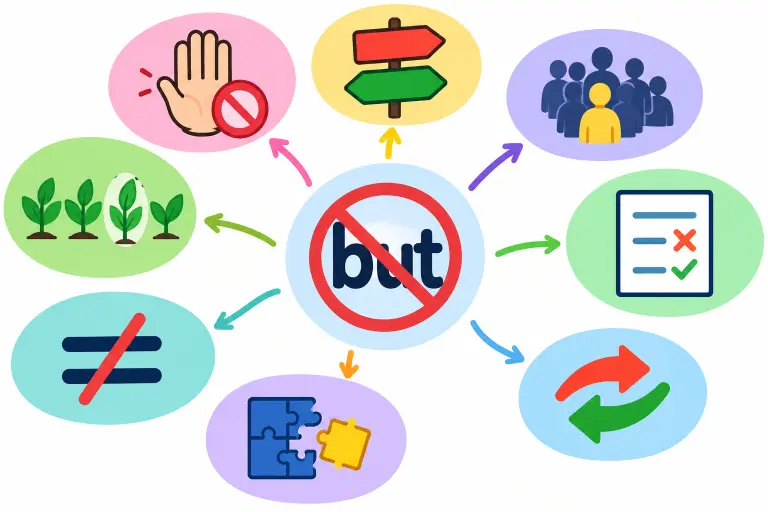
- Except
- Except for
- Apart from
- Other than
- Excluding
- With the exception of
These are not all interchangeable. For example, “however” can usually replace a contrastive “but” in meaning, while “except for” usually introduces an exception rather than a contrast between two complete ideas.
Formal Alternatives to But
Formal writing often benefits from more precise transitions. However, replacing every “but” with a formal-sounding word can make writing unnecessarily stiff. Choose the alternative according to the relationship between the ideas.
However
Meaning: Shows a contrast between two ideas.
Explanation: “However” is one of the most useful alternatives to “but,” especially in formal and professional writing. Unlike “but,” it normally functions as a conjunctive adverb rather than a coordinating conjunction.
Example: The proposal was expensive. However, the long-term benefits were significant.
Best Use: Essays, reports, business writing, professional emails, and analytical writing.
Worst Use: Avoid using “however” merely to sound sophisticated when a simple “but” would be clearer.
Tone: Neutral to formal.
Nevertheless
Meaning: Despite what has just been stated.
Explanation: “Nevertheless” emphasizes that the second point remains true despite the first point.
Example: The project faced several delays. Nevertheless, the team completed it on time.
Best Use: Formal reports, essays, presentations, and persuasive writing.
Worst Use: Casual conversation, where it can sound more formal than necessary.
Tone: Formal and emphatic.
Nonetheless
Meaning: Despite that; nevertheless.
Explanation: “Nonetheless” is very close in meaning to “nevertheless.” It introduces a statement that remains valid despite a previous fact.
Example: The evidence is limited. Nonetheless, the findings are worth considering.
Best Use: Academic, professional, and analytical writing.
Worst Use: Very casual messages where “still” or “but” would sound more natural.
Tone: Formal and polished.
Although
Meaning: Introduces a condition or fact that contrasts with the main idea.
Explanation: “Although” is a subordinating conjunction, so it normally introduces a dependent clause.
Example: Although the restaurant was crowded, we found a table quickly.
Best Use: Essays, formal writing, reports, and carefully structured sentences.
Worst Use: It does not work as a direct replacement for “but” in every sentence.
Tone: Neutral to formal.
Whereas
Meaning: Shows a clear difference between two people, things, situations, or ideas.
Explanation: “Whereas” is particularly useful when comparing two contrasting facts.
Example: The old system was manual, whereas the new system is fully automated.
Best Use: Comparisons, reports, academic writing, policies, and business documents.
Worst Use: It can sound unnecessarily formal in ordinary conversation.
Tone: Formal and comparative.
Conversely
Meaning: In the opposite way or direction.
Explanation: “Conversely” is stronger than ordinary contrast because it often signals an opposing situation or relationship.
Example: Online sales increased during the summer. Conversely, store visits declined.
Best Use: Analytical writing, reports, research, and formal comparisons.
Worst Use: Do not use it when the second idea is simply different rather than genuinely opposite.
Tone: Formal and analytical.
In Contrast
Meaning: Shows that one thing differs from another.
Explanation: “In contrast” works well when the writer wants to highlight a noticeable difference.
Example: The first plan focuses on speed. In contrast, the second prioritizes accuracy.
Best Use: Academic writing, reports, presentations, and comparisons.
Worst Use: It may be unnecessary when the contrast is already obvious.
Tone: Neutral to formal.
By Contrast
Meaning: Used to emphasize a difference between two situations.
Explanation: “By contrast” is closely related to “in contrast” and is especially useful when moving from one idea to another.
Example: The northern region remained dry. By contrast, the southern region received heavy rainfall.
Best Use: Formal comparisons and analytical writing.
Worst Use: Avoid using it where there is no clear comparison.
Tone: Formal and objective.
Even So
Meaning: Despite that; nevertheless.
Explanation: “Even so” acknowledges a previous point while introducing an idea that contrasts with it.
Example: The route is longer. Even so, it is much safer.
Best Use: Essays, professional communication, and thoughtful everyday writing.
Worst Use: It is less suitable when the relationship is not one of concession.
Tone: Neutral.
Despite This
Meaning: In spite of the fact just mentioned.
Explanation: “Despite this” connects a previous fact to an unexpected or contrasting result.
Example: The instructions were unclear. Despite this, everyone completed the task correctly.
Best Use: Reports, professional writing, academic assignments, and explanations.
Worst Use: It can sound repetitive if used in every paragraph.
Tone: Neutral to formal.
Semi-Formal and Neutral Alternatives

Simple alternatives are often the best choice because they preserve clarity without making a sentence sound overly formal.
Yet
Meaning: Despite that; nevertheless.
Explanation: “Yet” can replace “but” when the second idea is surprising or contrasts with the first.
Example: The task was difficult, yet she finished it quickly.
Best Use: Everyday writing, essays, stories, and professional communication.
Worst Use: Avoid it if the relationship is not genuinely contrastive.
Tone: Neutral and concise.
Still
Meaning: Despite what was mentioned.
Explanation: “Still” can introduce a contrasting thought, especially when the writer wants a conversational or slightly emphatic tone.
Example: The apartment is small. Still, it has everything we need.
Best Use: Everyday writing, personal communication, blogs, and informal professional writing.
Worst Use: It may be too conversational for highly formal legal or academic documents.
Tone: Neutral to conversational.
Though
Meaning: Despite the fact that; although.
Explanation: “Though” can function much like “although.” It is also common at the end of a sentence in informal English.
Example: I enjoyed the presentation, though it was longer than expected.
Best Use: Everyday communication, blogs, dialogue, and informal writing.
Worst Use: Avoid sentence-final “though” in highly formal writing if a more precise construction would be clearer.
Tone: Neutral to casual.
On the Other Hand
Meaning: Introduces a different or opposing point of view.
Explanation: This phrase is useful when comparing two sides of an issue. It is not a universal synonym for “but.”
Example: The apartment is affordable. On the other hand, it is far from the city center.
Best Use: Balanced discussions, essays, comparisons, and conversations.
Worst Use: Do not use it when there are not actually two contrasting sides.
Tone: Neutral.
While
Meaning: At the same time or in contrast with.
Explanation: “While” can show contrast when two clauses contain differing facts.
Example: While the first option is cheaper, the second is more reliable.
Best Use: Comparisons, essays, reports, and everyday writing.
Worst Use: Avoid it when the reader could interpret it as referring to time rather than contrast.
Tone: Neutral.
Instead
Meaning: In place of something else or as an alternative.
Explanation: “Instead” does not mean exactly the same thing as “but.” It usually signals replacement or a different choice.
Example: We planned to drive, but we took the train instead.
Best Use: Showing an alternative action or choice.
Worst Use: It should not replace “but” when the sentence simply needs a contrast.
Tone: Neutral.
Rather
Meaning: Preferably or more accurately.
Explanation: “Rather” can introduce a correction or preferred alternative, but it is not a general synonym for “but.”
Example: The problem is not the price. Rather, it is the delivery time.
Best Use: Corrections, clarification, and formal explanation.
Worst Use: Do not use it merely as a replacement for every occurrence of “but.”
Tone: Neutral to formal.
At the Same Time
Meaning: Despite one fact, another fact is also true.
Explanation: This phrase can balance two ideas without directly saying “but.”
Example: The software is powerful. At the same time, it requires some technical knowledge.
Best Use: Balanced discussions, reviews, reports, and explanatory writing.
Worst Use: It can become wordy when a simple “but” would communicate the idea more directly.
Tone: Neutral.
Informal and Casual Alternatives

There are fewer true casual synonyms for “but” because “but” itself is already short, natural, and conversational.
Though
Meaning: Although or despite that.
Example: I was tired. I went out with my friends, though.
When it sounds natural: Casual speech, text messages, conversations, and personal writing.
When to avoid it: Highly formal reports or legal documents.
Tone: Casual and conversational.
Still
Meaning: Even so; despite that.
Example: It was raining. Still, we decided to go.
When it sounds natural: Everyday conversation and informal writing.
When to avoid it: When a precise formal relationship between ideas is required.
Tone: Casual to neutral.
Yet
Meaning: Despite that.
Example: He knew it was risky, yet he tried anyway.
When it sounds natural: Conversation, stories, and everyday writing.
When to avoid it: Very technical contexts where a more exact transition is needed.
Tone: Neutral and concise.
Except
Meaning: Excluding someone or something.
Example: Everyone agreed except Mark.
When it sounds natural: Everyday conversation and simple statements of exception.
When to avoid it: When you are trying to show contrast rather than exclusion.
Tone: Neutral.
True Synonyms vs. Contextual Alternatives
The most important point about synonyms for “but” is that many alternatives are contextual alternatives rather than exact synonyms.
| Type | What It Means | Can It Replace the Original? |
|---|---|---|
| True or very close synonym | Expresses a similar contrast | Often, but grammar may change |
| Near synonym | Expresses a similar relationship with a small difference | Sometimes |
| Contextual alternative | Works in particular sentence structures | Only in suitable contexts |
| Broader expression | Shows a general relationship such as difference | Only when the meaning fits |
| Narrower expression | Expresses a specific kind of contrast or exception | Only for that specific purpose |
For example, “yet” is often a close alternative to “but”:
The task was difficult, but she completed it.
The task was difficult, yet she completed it.
The meaning remains almost the same.
However, “except” serves a different function:
Everyone attended except John.
Here, “except” expresses an exception, not ordinary contrast. Replacing it with “however” would change the sentence structure and meaning.
Similarly, “on the other hand” is useful for contrasting two perspectives, but it is not a direct substitute for “but” in every sentence.
Business Writing

Business writing usually benefits from clear, direct transitions rather than complicated vocabulary.
Useful Choices
However is a strong general-purpose option:
The proposal meets our budget requirements. However, the delivery schedule may need to be revised.
Although works well when combining ideas:
Although the initial cost is higher, the system should reduce maintenance expenses.
Nevertheless is useful when emphasizing that a positive conclusion remains valid:
The launch encountered several problems. Nevertheless, customer interest remained strong.
The goal is not to eliminate “but.” A sentence such as this is perfectly professional:
We can approve the request, but we need the revised figures first.
Clarity matters more than using formal vocabulary.
Corporate Communication
Reports, internal updates, policies, and announcements often require precise contrast.
Useful Choices
Use whereas for direct comparisons:
The previous policy applied to full-time employees, whereas the new policy applies to all staff.
Use however to introduce a limitation:
The system is ready for testing. However, final approval is still required.
Use despite this when connecting a previous problem with a later outcome:
Several suppliers increased their prices. Despite this, the department remained within budget.
Avoid replacing every “but” with a longer phrase. Concise corporate writing is generally easier to read.
Academic Writing
Academic writing often uses transitions such as however, although, nevertheless, whereas, in contrast, and despite this.
Useful Examples
Although the sample size was small, the results provide useful preliminary evidence.
The two studies reached similar conclusions. However, their methods were different.
The first theory emphasizes individual behavior, whereas the second focuses on social structures.
The results were unexpected. Nevertheless, they were consistent across several tests.
One caution: academic writing should not become overly formal simply for appearance. A clear “but” is grammatically correct and can sometimes be the best choice.
Customer Service

Customer service language should be polite, clear, and easy to understand.
Useful Examples
We understand your concern, but we need additional information before we can process the request.
Or:
We understand your concern. However, we need additional information before we can process the request.
For a softer tone, you might restructure the sentence:
Although we cannot issue a refund at this stage, we can offer an exchange.
The second structure can sound more considerate because it places the limitation within a complete explanation rather than beginning with a blunt refusal.
Legal Writing
Legal writing requires particular care because a seemingly simple alternative may change the scope or interpretation of a sentence.
Words such as however, although, except, unless, notwithstanding, provided that, and subject to can perform different legal functions. They should not be treated as interchangeable.
For example:
All employees may access the facility except contractors.
This creates an exception.
By contrast:
All employees may access the facility; however, access is restricted after 8 p.m.
This introduces a limitation or contrast.
Because legal meaning can depend on exact wording, writers should not replace a legal connector merely to avoid repetition. If a document has legal consequences, the intended meaning should take priority over stylistic variation.
Email Communication
Professional emails often need a softer or clearer alternative to “but,” especially when presenting a limitation.
Client Email
Subject: Project Timeline Update
Hi Sarah,
We have completed the first stage of the project. However, the final review will take two additional days because we received the remaining materials later than expected.
We expect to send the completed version by Thursday.
Best,
James
Internal Workplace Email
Subject: Revised Meeting Time
Hi Team,
The original meeting time worked well for most people. However, two members of the project team are unavailable at that time, so I suggest moving the meeting to 2 p.m.
Please let me know if that creates any conflicts.
Thanks,
Nina
Request Email
Subject: Request for Updated Invoice
Hello David,
Thank you for sending the invoice. Everything looks correct, except the billing address appears to be outdated.
Could you please send a revised copy?
Best,
Amina
Customer Service Email
Subject: Your Order Update
Hello Michael,
Your order has been processed. Unfortunately, the requested color is currently unavailable. However, we can offer the same product in black or gray.
Please let us know which option you prefer.
Kind regards,
Customer Support
Vendor Email
Subject: Delivery Schedule
Hello Mark,
We are happy to proceed with the order. However, we need the delivery completed by the 15th to meet our production schedule.
Please confirm whether this date is possible.
Best regards,
Daniel
Academic Email
Subject: Assignment Submission Question
Dear Professor Lee,
I have completed most of the assignment, but I am unsure about the required citation format for the final section.
Could you please confirm whether APA style should be used throughout?
Thank you,
Hannah
Short Dialogue Examples
Workplace
Person A: The report is nearly finished, but we still need the sales figures.
Person B: I can send those over this afternoon.
Classroom
Person A: I understand the first example, but the second one is confusing.
Person B: Look at how the two clauses are connected. The second one shows contrast.
Customer Service
Person A: I would like to return this item, but I no longer have the receipt.
Person B: That’s okay. We can check the purchase using your order number.
Casual Conversation
Person A: I wanted to go for a walk, but it started raining.
Person B: We can go later if the weather improves.
Professional Discussion
Person A: The new plan is more expensive.
Person B: True. Even so, it should reduce operating costs in the long term.
How to Replace “But” in a Sentence
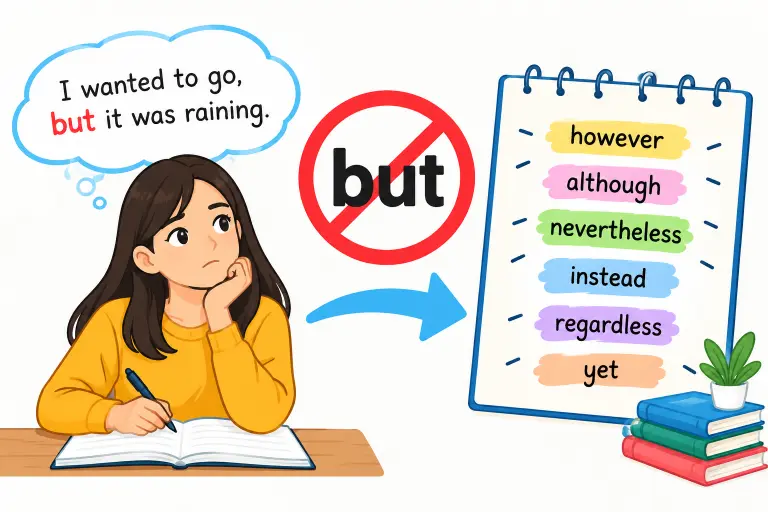
Example 1
Original: The course is difficult, but it is useful.
Alternative: The course is difficult, yet it is useful.
Why it works: “Yet” preserves the contrast and keeps the sentence concise.
Example 2
Original: The product is expensive, but customers continue to buy it.
Alternative: The product is expensive. However, customers continue to buy it.
Why it works: “However” works well in formal or professional writing. The punctuation and sentence structure change.
Example 3
Original: The apartment is small, but it is comfortable.
Alternative: Although the apartment is small, it is comfortable.
Why it works: “Although” changes the sentence structure by making the first clause dependent.
Example 4
Original: The old system is slow, but the new system is reliable.
Alternative: The old system is slow, whereas the new system is reliable.
Why it works: “Whereas” creates a direct comparison between the two systems.
Example 5
Original: The weather was poor, but the event continued.
Alternative: The weather was poor. Nevertheless, the event continued.
Why it works: “Nevertheless” emphasizes that the event continued despite the problem.
Example 6
Original: The instructions were confusing, but everyone completed the task.
Alternative: The instructions were confusing. Even so, everyone completed the task.
Why it works: “Even so” clearly shows that the second result occurred despite the first fact.
Example 7
Original: The hotel is far from downtown, but it is close to the airport.
Alternative: The hotel is far from downtown. On the other hand, it is close to the airport.
Why it works: “On the other hand” works when presenting a different aspect of the same situation.
Example 8
Original: Everyone attended but Maria.
Alternative: Everyone attended except Maria.
Why it works: Here, “but” means “except,” so “except” is more precise.
Example 9
Original: The proposal is promising, but it needs more evidence.
Alternative: The proposal is promising. However, it needs more evidence.
Why it works: “However” provides a polished transition suitable for analytical or professional writing.
Example 10
Original: The first option is cheaper, but the second is faster.
Alternative: The first option is cheaper, whereas the second is faster.
Why it works: “Whereas” highlights the contrast between two specific options.
Comparison of Useful Alternatives
| Phrase | Tone | Meaning / Scope | Best Use | Example |
|---|---|---|---|---|
| But | Neutral | Direct contrast | Almost any context | It is simple but effective. |
| However | Neutral/formal | Contrast | Business and academic writing | It is simple. However, it is effective. |
| Yet | Neutral | Strong or surprising contrast | General writing | It is simple, yet effective. |
| Although | Neutral/formal | Concession | Essays and formal writing | Although it is simple, it is effective. |
| Though | Neutral/casual | Concession | Conversation and informal writing | It is effective, though simple. |
| Nevertheless | Formal | Despite a previous point | Reports and academic writing | It was difficult. Nevertheless, we succeeded. |
| Nonetheless | Formal | Despite that | Formal analysis | The evidence is limited. Nonetheless, it matters. |
| Still | Casual/neutral | Despite that | Conversation and general writing | It was difficult. Still, we tried. |
| Whereas | Formal | Direct comparison | Reports and academic writing | A is cheap, whereas B is fast. |
| In contrast | Formal | Difference | Comparisons | In contrast, the second option is faster. |
| On the other hand | Neutral | Alternative viewpoint | Balanced discussions | It is cheap. On the other hand, it is slow. |
| Except | Neutral | Exclusion | Exceptions | Everyone came except Tom. |
Which Alternative Should You Choose?
For Formal Writing
Choose however, nevertheless, nonetheless, although, whereas, in contrast, or despite this, depending on the sentence.
For Business Communication
However, although, yet, and nevertheless are usually practical choices. Keep the language direct.
For Academic Writing
Use however, although, whereas, nevertheless, nonetheless, and in contrast when they accurately describe the relationship between ideas.
For Legal Writing
Do not choose an alternative simply because it sounds formal. Words such as except, unless, notwithstanding, provided that, and subject to can have specific functions. Precision should come first.
For Professional Email
However, although, yet, and except are useful depending on the context. A sentence beginning with “However” can sound polished without being overly formal.
For Everyday Conversation
Usually stick with but, yet, though, or still. Simple language often sounds more natural.
For Casual Messages
But, though, still, and yet are usually enough. There is rarely a reason to replace every “but” with a formal transition.
Grammar and Usage Guide
“But” as a Coordinating Conjunction
The most common use of “but” is to connect two contrasting ideas.
I wanted to go, but I was too tired.
When “but” joins two independent clauses, a comma normally appears before it.
She studied hard, but she did not pass.
“But” Meaning “Except”
“But” can also mean “except.”
Everyone but Alex agreed.
Here, except can replace “but”:
Everyone except Alex agreed.
This is a different meaning from contrastive “but.”
“However” Is Not Punctuated Like “But”
“However” is commonly used as a conjunctive adverb.
The plan looks good. However, we need more information.
It can also appear within a sentence:
The plan, however, needs more information.
Do not automatically copy the punctuation used with “but.”
“Although” Creates a Dependent Clause
Although the weather was bad, we went outside.
You can also place the dependent clause second:
We went outside although the weather was bad.
When the introductory “although” clause comes first, a comma normally separates it from the main clause.
“Though” Can Be More Conversational
Though it was expensive, we bought it.
In informal English, “though” can also appear at the end:
It was expensive, though.
This sentence-final use is natural in conversation but less suitable for highly formal writing.
Avoid Unnecessary Double Connectors
A common mistake is:
Although it was raining, but we went outside.
Use one structure:
Although it was raining, we went outside.
Or:
It was raining, but we went outside.
Do not combine “although” and “but” this way.
Common Mistakes to Avoid
Treating Every Alternative as an Exact Synonym
“However,” “except,” and “instead” do not perform the same grammatical function. Always check the meaning before replacing “but.”
Using Formal Words Just to Sound Intelligent
Replacing every “but” with “nevertheless” can make simple writing feel stiff.
Ignoring Punctuation
“But,” “however,” and “although” follow different punctuation patterns. Changing the connector may require changing the sentence structure.
Using “On the Other Hand” Without Two Sides
The phrase works best when you are comparing two perspectives, advantages, disadvantages, or situations.
Confusing Contrast With Exception
Compare:
Everyone attended but James.
Here, “but” means “except.”
Compare:
James wanted to attend, but he was sick.
Here, “but” shows contrast.
Overusing “However”
“However” is useful, but placing it at the beginning of every sentence can make writing repetitive.
Choosing a Word That Changes the Meaning
“Instead” usually indicates replacement. “Conversely” suggests an opposite relationship. “Except” indicates exclusion. They should not be used simply because they appear on a synonym list.
Forgetting the Audience
A legal document, academic essay, customer email, and text message may all require different wording.
When Not to Use “But”
When the Sentence Needs a More Precise Comparison
If you are directly comparing two subjects, whereas may be clearer.
The first model is cheaper, whereas the second is more powerful.
When You Need a Formal Transition Between Sentences
In a report, however may provide a smoother transition:
The first test produced positive results. However, the second test was inconclusive.
When You Mean “Except”
Use except when exclusion is the intended meaning.
Everyone agreed except Maria.
When You Need to Emphasize Persistence Despite a Problem
Nevertheless or nonetheless may communicate the relationship more clearly.
The evidence was limited. Nevertheless, the researchers continued.
When You Are Comparing Opposing Positions
On the other hand can work when presenting another side.
The job offers a higher salary. On the other hand, the commute is much longer.
When “But” Is Being Repeated Too Often
A few carefully selected alternatives can improve rhythm and readability. Do not replace every occurrence; simply vary the structure where it helps.
When “But” Is Actually the Clearest Choice
Sometimes the best alternative is no alternative at all. “But” is short, familiar, and grammatically correct. If it communicates the relationship perfectly, keeping it may be the strongest editorial decision.
Advanced Writer Tips
Tone Control
Use but and yet for simple, direct contrast. Use however for polished professional writing. Use nevertheless or nonetheless when you want stronger emphasis on the fact that something remains true despite a previous point.
Professional Email Etiquette
Avoid making professional emails sound artificially formal.
Compare:
We appreciate your proposal, but we need more information.
with:
We appreciate your proposal. Nevertheless, we require additional information.
The second is more formal, but the first may sound warmer and more natural. Choose based on the relationship with the recipient.
Politeness
The connector itself does not determine politeness. The entire sentence matters.
Compare:
We cannot approve this request, but we can review it next month.
with:
Although we cannot approve this request at this time, we would be happy to review it next month.
The second version softens the refusal by placing the limitation inside a broader, helpful statement.
Context Alignment
Before replacing “but,” ask what relationship exists between the two ideas:
- Simple contrast → but, yet
- Formal contrast → however
- Concession → although, though
- Strong persistence despite a problem → nevertheless, nonetheless
- Direct comparison → whereas
- Opposing viewpoint → on the other hand
- Exception → except, apart from
- Replacement → instead
This simple test prevents most synonym mistakes.
Precision
Do not choose a synonym because it looks sophisticated. Choose the word that describes the relationship accurately.
For example:
The first product is cheaper, whereas the second is more durable.
This is better than:
The first product is cheaper. Conversely, the second is more durable.
“Conversely” suggests a stronger opposition than the sentence necessarily contains.
Readability
A good writer does not avoid common words. Short, familiar words often produce stronger writing.
Instead of:
The product is affordable; nevertheless, it possesses several limitations.
You might simply write:
The product is affordable, but it has several limitations.
The second sentence is easier to read and does not lose meaning.
Related Questions
What Is Another Way to Say “But”?
Common alternatives include however, yet, although, though, nevertheless, nonetheless, still, even so, whereas, and in contrast. The best choice depends on the grammar and relationship between the two ideas.
What Is a Professional Alternative to “But”?
However is usually the safest professional alternative. Nevertheless and nonetheless can work when you want stronger emphasis, while although is useful when restructuring the sentence.
What Is a Formal Alternative to “But”?
Common formal choices include however, nevertheless, nonetheless, although, whereas, in contrast, and despite this. They are not identical, so select the one that matches the intended meaning.
What Can I Use Instead of “But” in an Essay?
Try however, although, yet, whereas, nevertheless, nonetheless, or in contrast. You do not need to remove every “but.” A correctly used “but” is completely acceptable in academic writing.
Is “But” Formal or Informal?
“But” is a neutral English word. It is suitable in formal, professional, academic, and casual contexts. More formal alternatives may be useful for variation or emphasis, but “but” itself is not inherently informal.
Can “However” Always Replace “But”?
No. “However” expresses contrast, but its grammar and punctuation differ from “but.” For example, “Everyone but John attended” cannot naturally become “Everyone however John attended.”
What Is the Difference Between “But” and “Although”?
“But” usually joins two contrasting clauses, while “although” introduces a dependent clause.
I wanted to leave, but I stayed.
Although I wanted to leave, I stayed.
The basic contrast is similar, but the sentence structure is different.
FAQs
What is the closest synonym for “but”?
Yet is one of the closest alternatives when “but” expresses contrast. However is also close in meaning, particularly when moving between complete sentences, although its punctuation and grammar differ.
Is “however” more formal than “but”?
Usually, yes. “However” often sounds more polished or formal, while “but” is simpler and more direct. Both are appropriate in many professional and academic contexts.
Can “though” replace “but”?
Often, yes, when both express contrast. However, “though” has different grammatical patterns and is generally more conversational than “however” or “nevertheless.”
What is a good alternative to “but” in academic writing?
However, although, whereas, nevertheless, nonetheless, and in contrast are useful choices. The best option depends on whether you are showing contrast, concession, comparison, or a different point of view.
What is the difference between “but” and “nevertheless”?
Both can show contrast, but “nevertheless” emphasizes that the second statement remains true despite the first. It is also generally more formal and often connects separate sentences.
What can I use instead of “but” to mean “except”?
Use except, except for, apart from, other than, or with the exception of, depending on the sentence.
Everyone but Sara came.
Everyone except Sara came.
Is it bad to use “but” repeatedly?
Not necessarily. “But” is a useful and natural word. Repetition can become noticeable in longer writing, though, so varying sentence structure and using accurate alternatives can improve flow.
Key Takeaways
- But is a neutral and highly useful word for showing contrast, and you do not need to avoid it completely.
- However, yet, although, though, nevertheless, and nonetheless can express contrast, but their grammar and tone differ.
- Except, apart from, and other than are alternatives when “but” means exclusion rather than contrast.
- Choose alternatives according to the audience: simple wording usually works best in conversation, while precise transitions can help in formal writing.
- Never replace “but” simply to sound sophisticated; the clearest and most accurate word is usually the best choice.
Conclusion
Finding the right synonym for but is less about memorizing a long list of replacement words and more about understanding the relationship between your ideas.
However is a reliable choice for professional and formal writing, while yet and though often sound natural in everyday English.
Although is useful when you want to restructure a sentence, whereas works well for direct comparisons, and nevertheless or nonetheless can emphasize that something remains true despite a previous point.
It is also important to remember that some alternatives have completely different functions.
Except expresses an exception, instead signals replacement, and on the other hand introduces another perspective.
These words should not be treated as interchangeable.
The best writing does not eliminate “but.” Instead, it uses the word when it is the clearest choice and switches to another expression when a different tone, structure, or meaning is needed.
Good word choice is ultimately about precision, readability, and context.



