
Love is one of the most meaningful words in English, but it does not always express exactly what you want to say.
You might love a person deeply, love a close friend, love a hobby, admire someone’s work, or feel strong affection for a family member.
In each case, a different word or phrase may communicate the feeling more accurately.
The best synonyms for love depend on meaning, intensity, relationship, and tone. Words such as adore, cherish, care for, and affection can be close alternatives, but they are not interchangeable in every sentence. This guide explains the most useful alternatives, from formal and professional expressions to warm, romantic, and casual choices, with clear examples so you can choose the right word naturally.
Quick Answer
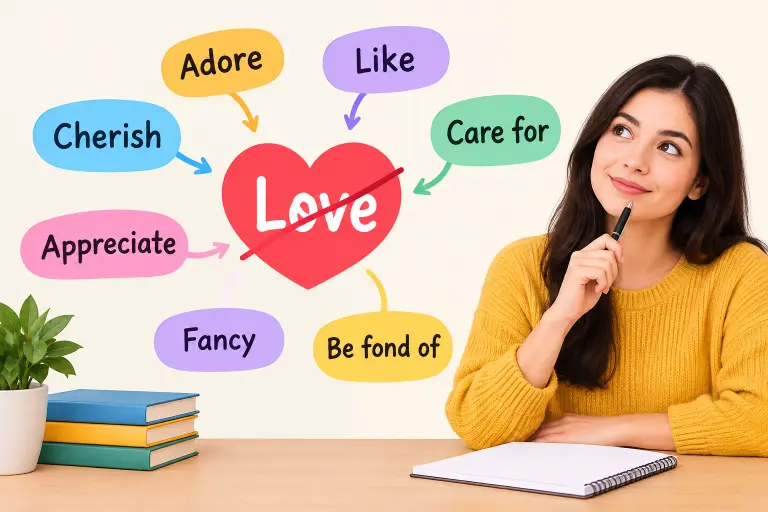
Common synonyms for love include adore, cherish, treasure, care for, admire, appreciate, fancy, adore, be fond of, be devoted to, have affection for, and hold dear. The best choice depends on context: cherish suggests deep emotional value, admire focuses on respect, and fancy is usually casual or romantic.
Quick List of Synonyms for Love
Closest and Most Useful Alternatives
- Adore
- Cherish
- Treasure
- Care for
- Be fond of
- Hold dear
- Have affection for
- Be devoted to
- Feel affection for
- Be attached to
- Appreciate
- Admire
- Prize
- Esteem
- Delight in
Romantic Alternatives
- Adore
- Cherish
- Be devoted to
- Be deeply attached to
- Have strong feelings for
- Be enamored with
- Be in love with
- Treasure
- Hold dear
Casual Alternatives
- Fancy
- Like
- Be into
- Have a thing for
- Dig
- Be crazy about
- Be fond of
Some casual expressions are highly informal and should not be used in academic, legal, or professional writing.
Formal Alternatives to Love
Cherish
Meaning: To value someone or something deeply.
Explanation: Cherish is one of the closest alternatives to love when you want to emphasize emotional value and care. It often suggests that someone or something is precious to you.
Example:
She cherishes the time she spends with her grandchildren.
Best Use: Personal writing, speeches, cards, relationships, and thoughtful expressions.
Worst Use: It can sound overly emotional in technical or highly objective writing.
Tone: Warm, sincere, affectionate.
Adore
Meaning: To love someone or something very much.
Explanation: Adore expresses strong affection and is often slightly more expressive than ordinary like. It can describe romantic feelings, family relationships, friendships, or enthusiasm for things.
Example:
He adores his young daughter.
Best Use: Personal conversations, literature, cards, and emotional writing.
Worst Use: It may sound exaggerated if the subject is something minor or purely practical.
Tone: Strong, warm, enthusiastic.
Treasure
Meaning: To value someone or something as extremely important or precious.
Explanation: Treasure does not always mean romantic love. It emphasizes how highly you value a person, memory, relationship, or experience.
Example:
I treasure the friendship we have built over the years.
Best Use: Personal messages, speeches, reflective writing, and emotional communication.
Worst Use: It may sound dramatic in routine workplace communication.
Tone: Deep, sentimental, appreciative.
Hold Dear
Meaning: To consider someone or something deeply valuable.
Explanation: Hold dear is a gentle expression of affection. It often focuses on emotional importance rather than romantic attraction.
Example:
She holds her childhood memories dear.
Best Use: Personal writing, speeches, literature, and heartfelt messages.
Worst Use: It can sound old-fashioned in very casual conversation.
Tone: Warm, sincere, slightly literary.
Be Devoted To
Meaning: To give strong loyalty, attention, or commitment to someone or something.
Explanation: Be devoted to can express love, but it adds the idea of commitment and loyalty. It is therefore not a perfect replacement in every sentence.
Example:
He is devoted to his family.
Best Use: Relationships, family, caregiving, biographies, and formal descriptions of commitment.
Worst Use: Avoid using it when you only mean that you enjoy something.
Tone: Serious, loyal, committed.
Have Affection for
Meaning: To feel warmth, fondness, or caring toward someone or something.
Explanation: This is a more measured expression than love. It is useful when you want to describe positive emotional feelings without suggesting intense romantic attachment.
Example:
She has great affection for her former students.
Best Use: Formal personal writing, biographies, professional descriptions, and careful emotional language.
Worst Use: It may sound distant if you are trying to express intense romantic feelings.
Tone: Polite, warm, restrained.
Be Fond Of
Meaning: To like someone or something warmly.
Explanation: Be fond of expresses affection, but usually with less intensity than love. It is especially useful for people, pets, activities, foods, and familiar things.
Example:
My grandfather was very fond of classical music.
Best Use: Everyday writing and conversation.
Worst Use: It may weaken the meaning if you intend to express deep romantic love.
Tone: Warm, gentle, moderate.
Esteem
Meaning: To respect and value someone highly.
Explanation: Esteem is related to love only in certain contexts. It focuses more on respect and high regard than emotional attachment.
Example:
The community holds the teacher in high esteem.
Best Use: Formal writing, biographies, professional communication, and public statements.
Worst Use: It is usually not a natural substitute for romantic love.
Tone: Formal, respectful, dignified.
Admire
Meaning: To respect, appreciate, or value someone for their qualities or achievements.
Explanation: Admire can overlap with love when affection grows from respect, but it does not necessarily imply emotional attachment.
Example:
I deeply admire her courage and honesty.
Best Use: Professional writing, personal communication, school assignments, and compliments.
Worst Use: Do not use it if you specifically mean romantic or passionate love.
Tone: Positive, respectful, appreciative.
Appreciate
Meaning: To recognize the value, importance, or good qualities of someone or something.
Explanation: Appreciate is broader and less emotionally intense than love. It is particularly useful in professional and polite communication.
Example:
We greatly appreciate your continued support.
Best Use: Emails, customer service, workplace communication, formal writing, and gratitude.
Worst Use: It can sound too weak when expressing deep personal attachment.
Tone: Polite, professional, grateful.
Semi-Formal and Neutral Alternatives

Care For
Meaning: To feel affection for someone or to look after them.
Explanation: Care for can mean emotional affection, but it can also mean providing care. Context determines the meaning.
Example:
She cares deeply for her younger brother.
Best Use: Personal communication, relationships, and thoughtful writing.
Worst Use: Avoid ambiguity when the sentence could be interpreted as referring only to physical care.
Tone: Warm, sincere, neutral.
Prize
Meaning: To value someone or something highly.
Explanation: Prize is less common than love but can express deep appreciation and value.
Example:
He prizes the trust his colleagues have placed in him.
Best Use: Formal or literary writing.
Worst Use: It may sound unnatural in everyday conversation.
Tone: Formal, thoughtful.
Value
Meaning: To consider someone or something important and worthwhile.
Explanation: Value is not a direct synonym for emotional love, but it can replace love when the intended meaning is appreciation or importance.
Example:
We value the relationship we have with our customers.
Best Use: Business writing, professional communication, and neutral statements.
Worst Use: It can sound emotionally distant in a romantic message.
Tone: Neutral, professional.
Appreciate
Meaning: To recognize and be grateful for someone’s qualities or actions.
Example:
I really appreciate everything you have done for me.
Best Use: Thank-you messages, workplace communication, and everyday conversation.
Worst Use: It does not necessarily communicate emotional attachment.
Tone: Warm, polite, professional.
Be Attached To
Meaning: To have a strong emotional connection to someone or something.
Explanation: Be attached to suggests emotional connection but does not necessarily mean love. A person can be attached to a place, object, tradition, or memory.
Example:
She is deeply attached to her childhood home.
Best Use: Personal writing and emotional descriptions.
Worst Use: Avoid it if you want to communicate active romantic affection.
Tone: Emotional, neutral.
Delight In
Meaning: To take great pleasure or enjoyment in something.
Explanation: This phrase can overlap with love when discussing enjoyment, but it is more about pleasure than emotional attachment.
Example:
The children delight in spending time outdoors.
Best Use: Descriptive and literary writing.
Worst Use: It is not a natural replacement for romantic love.
Tone: Expressive, somewhat literary.
Informal and Casual Alternatives
Fancy
Meaning: To feel attracted to or interested in someone.
Example:
I think she fancies him.
When It Sounds Natural: Casual British English and informal romantic conversations.
When to Avoid It: Avoid it in formal American English because the intended meaning may not be immediately clear.
Tone: Casual, playful, often romantic.
Be Into
Meaning: To be strongly interested in someone or something.
Example:
She’s really into him.
When It Sounds Natural: Casual conversation, texting, and informal social situations.
When to Avoid It: Do not use it in academic papers or formal business communication.
Tone: Very casual.
Have a Thing For
Meaning: To have a romantic or physical attraction toward someone.
Example:
He has always had a thing for her.
When It Sounds Natural: Informal conversation and friendly discussion.
When to Avoid It: Avoid it in professional or formal writing.
Tone: Casual, playful.
Be Crazy About
Meaning: To like or love someone or something intensely.
Example:
She’s crazy about her new puppy.
When It Sounds Natural: Informal conversation and enthusiastic personal writing.
When to Avoid It: It may sound exaggerated in serious or professional contexts.
Tone: Energetic, enthusiastic, informal.
Dig
Meaning: To like or enjoy someone or something.
Example:
I really dig this new band.
When It Sounds Natural: Very casual speech and informal writing.
When to Avoid It: Avoid it in formal communication and academic writing.
Tone: Slangy, relaxed.
True Synonyms vs. Contextual Alternatives
Not every word connected with love can replace it in every sentence. Understanding this distinction helps you write more accurately.
| Type | What It Means | Can It Replace the Original? |
|---|---|---|
| True synonym | A word with nearly the same core meaning | Often, but context still matters |
| Near synonym | A word with a closely related meaning | Sometimes |
| Contextual alternative | A phrase that works in a particular situation | Only in suitable contexts |
| Broader expression | A term covering a wider idea | Sometimes, if the wider meaning is intended |
| Narrower expression | A term describing one specific type of love or affection | Only when that specific meaning is intended |
For example, adore is a close alternative to love, while admire is narrower in emotional meaning because it emphasizes respect. Appreciate can work when love means valuing something, but it does not necessarily communicate affection. Be devoted to adds commitment, while fancy adds romantic attraction.
Industry-Specific Usage

Business Writing
In business writing, love is usually too personal unless the company is discussing customers, branding, or enthusiasm in a marketing context.
Useful alternatives include:
- Appreciate
- Value
- Respect
- Support
- Prefer
- Be committed to
Example:
Instead of:
We love working with your company.
A more professional version is:
We greatly value our partnership with your company.
The second version sounds more appropriate for formal business communication because value communicates appreciation without sounding overly personal.
Corporate Communication
Corporate communication often benefits from precise, measured language.
Example:
We value the trust our employees place in the organization.
Here, value is more suitable than love because the statement concerns professional relationships.
For employee recognition, appreciate, respect, and value are often effective choices.
Academic Writing
Academic writing generally avoids emotional language unless the subject itself concerns emotion, literature, psychology, culture, or relationships.
Instead of:
Many people love social media.
A more academic version could be:
Many people have a strong attachment to social media.
However, the correct alternative depends on the evidence and argument. Do not replace love simply to sound academic if the original word is part of a quotation or directly reflects the research subject.
Customer Service
Customer service writing should sound warm without becoming overly personal.
Useful alternatives include:
- Appreciate
- Value
- Be grateful for
- Be pleased with
- Thank
Example:
We appreciate your patience while we resolve this issue.
This is usually more natural than:
We love your patience.
Legal Writing
Legal writing requires precision. Words related to love, affection, preference, loyalty, or attachment may have different meanings depending on the legal document and jurisdiction.
Do not casually replace a legally defined term with a synonym. In legal documents, a word that seems emotionally similar may change the intended scope or create ambiguity.
For example, care for, support, maintain, custody, and responsibility can have very different meanings in legal contexts. A general synonym list should not be treated as a substitute for jurisdiction-specific legal terminology.
Email Communication
Professional emails usually benefit from alternatives such as appreciate, value, admire, and be grateful for.
Example:
I appreciate your quick response.
This is more appropriate than:
I love your quick response.
For a personal email, however, love, adore, or cherish may be exactly right.
Email Examples
Client Appreciation Email
Subject: Thank You for Your Continued Partnership
Dear Sarah,
I wanted to let you know that we truly appreciate the trust you have placed in our team. Your feedback has helped us improve the project, and we value the opportunity to continue working together.
Thank you again for your time and support.
Best,
Daniel
Project Update Email
Subject: Thank You for Your Support
Hi Michael,
I appreciate your support during the latest phase of the project. Your quick feedback helped us resolve several issues before the deadline.
We are now moving into the final review stage and expect to have the updated version ready tomorrow.
Best,
Emma
Academic Email
Subject: Thank You for Your Guidance
Dear Professor Ahmed,
I am writing to say that I greatly appreciate the guidance you provided during my research project. Your comments helped me understand how to improve both the structure and clarity of my argument.
Thank you for your time.
Kind regards,
Amina
Customer Service Email

Subject: Thank You for Your Patience
Dear Mr. Khan,
Thank you for your patience while we investigated the issue with your order. We understand that the delay was frustrating, and we appreciate your understanding.
Your replacement has now been shipped.
Kind regards,
Customer Support Team
Personal Email
Subject: A Small Thank You
Dear Mom,
I just wanted to tell you how much I cherish the time we spend together. Your support has meant more to me than I can easily put into words.
Thank you for always being there.
Love,
Ayesha
Short Dialogue Examples
Workplace
Person A: How do you feel about working with this team?
Person B: I really value the trust we’ve built. Everyone is willing to help when something goes wrong.
Classroom
Person A: Why do you admire that writer?
Person B: I admire her because she explains difficult ideas in a very simple way.
Customer Service
Person A: Thank you for helping me fix the problem.
Person B: You’re very welcome. We appreciate your patience.
Casual Conversation
Person A: Are you into that new series?
Person B: Absolutely. I’m crazy about it!
Professional Discussion
Person A: What makes this partnership successful?
Person B: We value open communication and respect each other’s expertise.
How to Replace “Love” in a Sentence
Example 1
Original:
I love spending time with my family.
Alternative:
I cherish the time I spend with my family.
Why it works:
Cherish adds a stronger sense of emotional value and appreciation.
Example 2
Original:
We love working with your company.
Alternative:
We greatly value our partnership with your company.
Why it works:
Value is more professional and fits business communication better.
Example 3
Original:
She loves her children deeply.
Alternative:
She is deeply devoted to her children.
Why it works:
Devoted emphasizes commitment as well as affection.
Example 4
Original:
I love this book.
Alternative:
I absolutely adore this book.
Why it works:
Adore preserves the enthusiastic feeling while making the sentence more expressive.
Example 5
Original:
He loves classical music.
Alternative:
He is very fond of classical music.
Why it works:
Be fond of expresses strong enjoyment without suggesting romantic or emotional attachment.
Example 6
Original:
I love how carefully you handled the situation.
Alternative:
I really appreciate how carefully you handled the situation.
Why it works:
Appreciate focuses on recognizing the value of someone’s action.
Example 7
Original:
She loves him.
Alternative:
She adores him.
Why it works:
Adore is a close emotional alternative and can preserve the romantic meaning.
Example 8
Original:
They love their old house.
Alternative:
They are deeply attached to their old house.
Why it works:
Attached to emphasizes emotional connection to a place rather than simply affection.
Example 9
Original:
I love this new design.
Alternative:
I really like this new design.
Why it works:
Like lowers the intensity and sounds more neutral.
Example 10
Original:
He loves spending time outdoors.
Alternative:
He delights in spending time outdoors.
Why it works:
Delights in emphasizes the pleasure he gets from the activity and has a more literary tone.
Comparison Table
| Phrase | Tone | Meaning / Scope | Best Use | Example |
|---|---|---|---|---|
| Love | Neutral to emotional | Strong affection or deep enjoyment | General use | I love my family. |
| Adore | Warm, expressive | Very strong affection | Personal and romantic contexts | She adores her son. |
| Cherish | Deep, sentimental | Value deeply | Relationships and memories | I cherish our friendship. |
| Treasure | Sentimental | Consider precious | Personal writing | I treasure these memories. |
| Care for | Warm, neutral | Feel affection or provide care | Relationships | He cares deeply for her. |
| Be fond of | Gentle | Like warmly | Everyday conversation | She is fond of cats. |
| Appreciate | Polite, professional | Recognize value | Work and gratitude | We appreciate your help. |
| Admire | Respectful | Value someone’s qualities | Work, school, compliments | I admire her honesty. |
| Value | Neutral, professional | Consider important | Business writing | We value your feedback. |
| Be devoted to | Serious, loyal | Strong commitment | Family and relationships | He is devoted to his family. |
| Hold dear | Warm, literary | Consider precious | Speeches and personal writing | She holds the memory dear. |
| Fancy | Casual | Feel romantic attraction | Informal British English | He fancies her. |
| Be into | Very casual | Be interested in | Conversation | She’s into him. |
| Be crazy about | Casual, enthusiastic | Like intensely | Informal speech | He’s crazy about football. |
Which Alternative Should You Choose?
For Formal Writing
Choose value, appreciate, admire, esteem, or have affection for, depending on the intended meaning.
If you need emotional warmth without sounding overly personal, have affection for can be useful.
For Business Communication
Choose value or appreciate.
For example:
We value your partnership.
or:
We appreciate your continued support.
These phrases are professional without sounding cold.
For Academic Writing
Choose the most precise phrase rather than simply replacing love with a more sophisticated word.
Depending on the context, strong attachment, affection, preference, admiration, or positive attitude may be more accurate.
For Legal Writing
Use the terminology appropriate to the document and jurisdiction. Do not substitute emotional synonyms where a legal term has a specific meaning.
For Professional Email
Use appreciate, value, admire, or be grateful for.
These expressions usually sound natural and respectful.
For Everyday Conversation
Use love, like, adore, be fond of, care for, or be into, depending on the level of intensity and formality.
For Casual Messages
Expressions such as be crazy about, have a thing for, fancy, and be into can work, but they are highly dependent on dialect and context.
Grammar and Usage Guide

Love as a Verb
Love commonly functions as a transitive verb and is followed by a noun, pronoun, or gerund.
Examples:
I love music.
She loves him.
They love traveling.
The third example uses a gerund, traveling, after the verb.
Love as a Noun
Love can also function as a noun.
Examples:
Their love grew stronger over time.
She expressed her love for her family.
The common structure love for + noun is useful when describing affection toward a person, group, activity, or thing.
Love for vs. Love of
Both love for and love of are grammatical, but they are not always used in exactly the same way.
Love for often emphasizes affection directed toward someone or something:
His love for his children was obvious.
Love of can describe affection, enjoyment, or a general appreciation:
Her love of literature influenced her career.
Adore
Adore is normally followed directly by the object.
I adore my grandmother.
She adores classical music.
Avoid adding an unnecessary preposition:
I adore her.
is natural, while I adore to her is incorrect.
Cherish
Cherish also takes a direct object.
We cherish our friendship.
She cherishes the memories.
Do not normally say cherish for when using the verb.
Be Fond Of
The phrase be fond of requires of.
He is fond of dogs.
She is fond of her old teacher.
A common mistake is to omit of.
Care For
Care for can have two meanings.
I care for my parents.
This can mean that I feel affection for them or that I look after them.
Would you care for some tea?
Here, it is a polite way to ask whether someone would like something.
Context determines the meaning.
Capitalization and Punctuation
Words such as love, adore, cherish, and admire do not normally require capitalization unless they begin a sentence or appear in a title where title capitalization is being used.
Punctuation follows ordinary sentence rules.
I love this book, but I prefer the sequel.
A comma separates the two independent clauses joined by but.
Common Mistakes to Avoid

Treating Every Alternative as an Exact Synonym
Admire and love are related but not identical. You can admire someone without loving them.
Using “Appreciate” for Romantic Love
Appreciate usually communicates recognition or gratitude, not romantic attachment.
I appreciate you.
does not necessarily mean the same thing as:
I love you.
Using Casual Expressions in Formal Writing
Phrases such as be into, have a thing for, and dig are inappropriate in most academic and professional writing.
Making the Meaning Too Strong
Replacing like with adore or love can exaggerate the speaker’s feelings.
I adore this pen.
may sound playful, but it is much stronger than:
I like this pen.
Using “Devoted” Without Commitment
Devoted suggests loyalty, dedication, or sustained commitment. It is not simply another word for like.
Confusing Admiration With Affection
You may admire someone’s intelligence without feeling affection for them.
Ignoring Regional Differences
Fancy is common in British English as a casual expression for romantic attraction, while American speakers may interpret it differently depending on context.
Choosing a Fancy Word Instead of a Precise Word
A sophisticated-sounding word is not automatically better. The best alternative is the one that communicates your intended meaning clearly.
When Not to Use the Original Phrase
When the Context Is Professional
In formal workplace communication, love can sometimes sound too personal.
We love your feedback.
may be better written as:
We appreciate your feedback.
When You Mean Respect
If you mean respect rather than affection, use admire or esteem.
I admire her leadership.
is more precise than:
I love her leadership.
When You Mean Gratitude
If you mean that someone did something helpful, appreciate may be more accurate.
I appreciate your help.
is clearer than:
I love your help.
When You Mean Commitment
If the key idea is loyalty or dedication, be devoted to may communicate the intended meaning better.
When You Mean Romantic Attraction
If you specifically mean attraction rather than deep emotional attachment, be attracted to, fancy, or have a thing for may be more precise depending on formality.
When You Mean Enjoyment
If you are talking about a hobby, activity, or product, enjoy, like, or be fond of may be more appropriate.
When “Love” Is Actually the Best Choice
Do not replace love simply to avoid repetition. It is a clear, natural, flexible word, and sometimes it is exactly the right choice.
For example:
I love my children.
There is no need to replace love with a more complicated expression unless you want to create a specific effect.
Advanced Writer Tips

Tone Control
Choose words according to emotional intensity.
Neutral: like, appreciate, value
Warm: care for, be fond of, admire
Deep: cherish, treasure, hold dear
Strong: adore, be devoted to
Casual: be into, fancy, be crazy about
This allows you to control how strongly the sentence sounds.
Professional Email Etiquette
Professional writing should communicate warmth without becoming overly personal. Appreciate and value are especially useful because they show gratitude while maintaining professional distance.
Instead of:
We love everything you have done.
Try:
We greatly appreciate everything you have done.
Politeness
Small word choices can change the emotional distance of a sentence.
Compare:
I love your suggestion.
with:
I appreciate your suggestion.
The first sounds enthusiastic and personal. The second sounds more professional and measured.
Context Alignment
Think about three things before replacing love:
- Who is reading the sentence?
- What exactly do you mean by love?
- How strong should the emotion sound?
A romantic message, school essay, business email, and customer-service response may all require different vocabulary.
Precision
Ask what kind of feeling you actually mean.
Is it:
- Romantic attraction?
- Deep affection?
- Respect?
- Gratitude?
- Enjoyment?
- Loyalty?
- Emotional attachment?
- Enthusiasm?
Once you identify the exact meaning, the right alternative becomes much easier to choose.
Readability
Do not use a long phrase when a simple word works better.
For example:
We greatly appreciate your continued support.
is clearer than an unnecessarily elaborate expression such as:
We would like to communicate our profound recognition of the emotional value associated with your continued support.
Simple language is often stronger language.
Related Questions
What Is Another Way to Say Love?
Common alternatives include adore, cherish, treasure, care for, be fond of, hold dear, and be devoted to. The best choice depends on whether you mean romantic affection, family affection, enjoyment, appreciation, or commitment.
What Is a Professional Alternative to Love?
In professional writing, appreciate and value are usually the safest choices. For example, replace “We love your support” with “We greatly appreciate your support.”
What Is a Formal Alternative to Love?
Possible formal alternatives include have affection for, cherish, value, esteem, admire, treasure, and be devoted to. Each has a slightly different meaning, so choose based on context rather than formality alone.
Is Love a Formal Word?
Love is neither strictly formal nor informal. It is a common, neutral English word that works in many settings. Its suitability depends on what you are describing and who your audience is.
Can “Adore” Replace “Love”?
Often, yes. Adore is a close alternative when you mean strong affection or enthusiasm. However, it can sound more expressive than love, so it may not fit every sentence.
What Is the Difference Between Love and Admire?
Love generally expresses deep affection, while admire focuses on respect or appreciation for someone’s qualities or achievements. You can admire someone without loving them.
What Is the Difference Between Love and Cherish?
Love is broader, while cherish emphasizes valuing someone or something deeply. Cherish often carries a gentle, sentimental feeling and is especially natural for relationships, memories, and meaningful experiences.
FAQs
What Is the Best Synonym for Love?
There is no single best synonym. Adore is a close choice for strong affection, cherish works well for deep emotional value, appreciate suits professional communication, and value is useful when you mean importance or respect.
What Is a Stronger Word Than Love?
Words such as adore, cherish, treasure, and be devoted to can sound stronger or more emotionally specific than love. However, strength depends on context.
What Is a Romantic Synonym for Love?
Adore, cherish, be devoted to, be in love with, and have strong feelings for can express romantic affection. The best choice depends on how intense or direct you want to sound.
What Is a Simple Word for Love?
Like can be a simpler and weaker alternative when you mean enjoyment or positive feelings. Care for is another simple option when discussing affection toward a person.
What Is a Professional Way to Say “I Love It”?
In professional communication, try “I really appreciate it,” “I value it,” “I think it is excellent,” or “I am very pleased with it.” The right option depends on whether you mean gratitude, approval, or enthusiasm.
Is “Cherish” More Emotional Than “Love”?
Often, yes. Cherish highlights the emotional value and preciousness of someone or something. It can sound more sentimental than the broader word love.
Is “Adore” Formal or Informal?
Adore is standard English and can appear in both formal and informal writing, but it usually carries a warm or expressive emotional tone. It is not as neutral as love.
Key Takeaways
- Adore, cherish, and treasure are strong alternatives when you want to express deep affection or emotional value.
- Appreciate and value are usually better choices for professional and business communication.
- Admire expresses respect or appreciation and does not necessarily mean romantic or emotional love.
- Casual phrases such as be into, fancy, and have a thing for should be used mainly in informal situations.
- Always choose a synonym based on meaning, audience, tone, and context, not simply because it sounds more sophisticated.
Conclusion
The best synonyms for love are not simply interchangeable words. Each one highlights a different part of the feeling.
Adore suggests strong affection, cherish emphasizes deep emotional value, treasure suggests that someone or something is precious, and be devoted to adds commitment and loyalty.
In professional settings, appreciate and value are usually more natural, while casual expressions such as be into and fancy are better suited to informal conversation.
The key is to identify what you actually mean before choosing an alternative. You mean romantic affection, choose language that communicates attraction or intimacy.
Mean gratitude, use appreciate. If you mean respect, admire may be more accurate. If you mean enjoyment, like or be fond of may work better.
And when the simple word love expresses your meaning perfectly, there is no reason to replace it.
Good writing is not about using the fanciest synonym; it is about choosing the clearest and most precise word for the moment.



